Live camera
Okama, Mount Zao live camera — Miyagi / Yamagata border
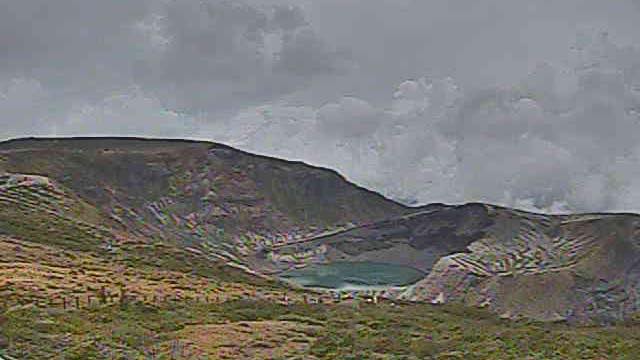
Okama sits small in the middle of the frame, beyond the ridge in front. The view is from the Katta side, so when cloud drops the green water disappears. Updated every two minutes by the Japan Meteorological Agency.
 Sample August 2026
What you are looking at
An emerald crater lake seen from the rim above it. Okama is also called Goshiki-numa, the five-coloured pond, because the water changes colour with the light.
It is about 360 metres across and a little over 27 metres at its deepest. The water is strongly acidic and holds no fish. The green comes from dissolved minerals scattering the light: dull grey-green under cloud, vivid on a clear day with the sun high.
Goshikidake, the cone that holds Okama, is a young crater that began to erupt about 2,000 years ago. In the record, falling rock caused casualties among people and livestock in November 1230, and in 1694 a shrine burned down and the rivers turned poisonous enough to kill the fish. More recently, volcanic tremor was observed here for the first time in January 2013, and in October 2014 part of the lake surface on the east side of Okama was seen to turn milky white.
The Zao Echo Line, the road that runs past Okama, closes for winter, so from around November until around April you cannot get here at all. For those months this camera is effectively the only way to see the lake — and a crater lake sealed in snow and ice is worth more for being out of reach.
This is a Japan Meteorological Agency volcano-monitoring camera, and the still refreshes every two minutes. The site is high enough to sit inside the clouds a good deal of the time, so if the frame is white, leave it a while and come back.
About this camera
| Place | Miyagi / Yamagata border |
| Format | Still, every 2 min |
| Time zone | Asia/Tokyo (UTC+9) |
| Category | Volcano · Nature |
| Operator | Japan Meteorological Agency — volcano surveillance cameras |
| Terms of use | PDL 1.0 |
The operator's own page
The footage belongs to each agency. This site is an unofficial guide, and each sample frame was copied once per camera under that agency's terms of use.