Nature
Kagamiganaru, Daisen: 1 Live Camera in Japan
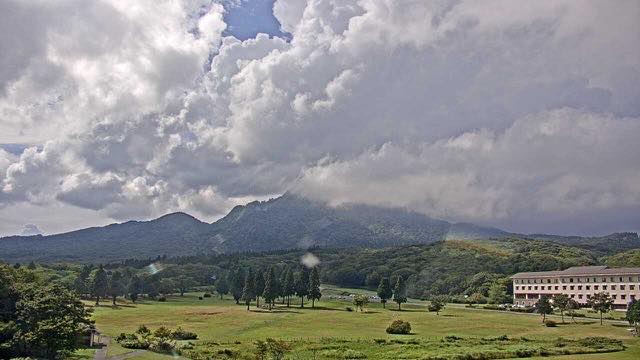
From the Kagamiganaru highland southeast of Mount Daisen, a Ministry of the Environment camera looks across grassland at the sharp peak of Mount Karasugasen.
What you can see
Kagamiganaru is a highland inside Daisen-Oki National Park: open grass, with the mountain standing beyond it.
The peak in the centre of frame is Mount Karasugasen, which continues southeast from Daisen. Where Daisen itself is broad and gentle, this one comes to a point. The contrast between the grass in front and the outline behind makes it obvious at a glance how clear the air is.
This site has no camera facing Mount Daisen itself. What you see here is Karasugasen, not Daisen — part of the same massif, but worth keeping straight.
The difference in gentleness from Daisen comes down to how sticky the lava was. A sharp peak like Karasugasen is what you get when viscous lava piles up over the vent instead of spreading out. Kagamiganaru in the foreground is a hollow ringed by Karasugasen, Giboshiyama and Zoyama, and that is why flat grassland survived there. A pointed mountain and a flat meadow standing next to each other is not coincidence: it is one episode of volcanic activity leaving different shapes in different places.
Cameras you can watch now: 1
All 1 are still images. Tap one to open it in the camera list.
-
 Sample August 2026
Mount Karasugasen from Kagamiganaru
Kofu, Tottori · Nature
The sharp cone of Karasugasen seen from the plateau southeast of Mount Daisen. The grassland in front sets off the outline cleanly.
When to watch
The grass changes with the season and takes the picture with it: green through summer, dry gold in autumn, white under snow in winter. The mountain's shape reads best on a clear winter morning with snow on it.
Refreshes hourly, and shows nothing after dark.
If it isn't showing
The camera is a still image refreshed once an hour, so the moment a cloud parts is not in it. A ridge hidden in one frame can be out in the next. Nothing moving is kept either — wind crossing the grass, a bird passing through, none of that registers. After dark the frame is black.
Tottori has only two cameras. The other is the Yonago Waterbird Sanctuary, gathered on Wintering Swans. It is the same Ministry of the Environment feed on the same hourly refresh, but its subject only appears in winter — an entirely different reason to open a camera. Both sit together on the Tottori page.
For the same composition — a flat surface in front, a mountain standing behind it — see Oze and Midagahara, Tateyama. Part of why a still frame here looks so static is that what it points at does not move.
Where to find Kagamiganaru, Daisen
Agencies publishing the cameras on this page
- Ministry of the Environment — Internet Nature Institute (PDL 1.0) — Official site
The footage belongs to each agency. This site is an unofficial guide, and each sample frame was copied once per camera under that agency's terms of use.